

Building Introvert Internal Compass. Risk Levels. Part 2
Why your risk tolerance is the ultimate gatekeeper to a life that actually fits you, and how to assess your 6 risk levels.

This post is an invitation to stop playing it safe by someone else's rules and start mapping your personal risk profile to finally let your true life in.
“So many sensitive, thoughtful, introverted, or over-adapted people become very good at building a life that looks ‘sensible’ from the outside — but slowly drains them on the inside.”
I especially love the idea of the internal compass.
At some point, the deeper question is not only, “Am I succeeding?”
It is: “Am I succeeding at a life that actually fits me?”
And perhaps realignment begins when we stop asking only what others expect from us, and start listening for our own true north.
These are the words of Mandy Lyons, whose publication Hard Head Soft Heart might be the perfect corner of Substack for you if you feel deeply, think carefully, and are learning to come home to yourself.
By the time we reach midlife, introverts usually realize that they have been running on someone else’s software and that their validation is placed externally.
This is not a surprise.
From early on in life, we learn that blending in and mimicking what works for others is the most effective way to meet our needs.
We do this to guarantee everything from physical safety and the connection and belonging, to higher needs like personal growth or contribution.
But we all know that wearing masks comes with a heavy price.
We go from constantly scanning the outside noise to validate if we are operating exactly as they expect, to the heavy realization that our “second identity” is no longer just a backup. It has grown into our inner self and warped it.
This is how we end up with that “life that looks “sensible” from the outside”.
All the checkboxes are checked, except the one that matters: “Is my life actually fitting me?”
This is why an introvert’s life realignment is fundamentally a move from external to internal validation.
It is a journey from mimicking to trusting ourselves again.
From reacting to external noise to tuning into our own voice.
It requires untangling the past as well as having a lot of honest conversations with ourselves.
Overall, it requires what we can call “confidence.”
Welcome to Life Realignment for Introverts.
If you have spent years being good at a life that does not quite fit, you are in the right place. No passion chasing. No reckless leaps. No advice designed for extroverts. Just a structured path to realign your internal world with your external one.
Cultivating Self-awareness
I agree with Dr. Dan Rosenfeld who says:
“Confidence is often seen through the lens of extroverted traits, like being outgoing, sociable, and assertive. But for introverts, confidence manifests differently.
It involves deep self-reflection, self-acceptance, and self-regulation. […]
It requires a strategic approach to vulnerability, an adaptive form of resilience, and an inquisitive journey toward self-discovery.
Introverts build confidence, not by striving to match outgoing, extroverted ideals, but by cultivating self-awareness and finding strength in their individuality.”
(Rosenfeld, Dan. The Confidence Equation: Three Keys to Unleashing Self-Confidence as an Introvert)
After years of blending in and mimicking, “cultivating self-awareness and finding strength in our individuality” might be the exact way to finally orient our introverted internal compass. It allows us to start following it to actually discover what is ours and what is not.
To start calibrating your internal compass, you might want to reflect on these 3 pillars:
We have already explored the topic of how to stop living on borrowed values and find your true ones. You can check Part 1 of this series here.

Now, we will explore the topic of risk tolerance and how it holds the key to letting your true life in.
What is Risk Tolerance?
Most people think of risk-taking as binary: either you are a risk-taker, or you aren’t. But risk-taking is much more nuanced than that.
Since you have already reviewed your core values and understood what you want more (or less) of in your life, it is time to look at these elements through the perspective of risk.
Let’s assume you want more adventure in your life. To make that happen, you need to understand your current willingness to actually let it in.
So, at its core, risk tolerance is the internal thermostat that dictates how much uncertainty you are willing to let into your world.
It is the exact threshold where your desire for change meets your need for safety.
If your core values are the destination you want to reach, your risk tolerance is the gatekeeper deciding how far you are actually allowing yourself to go.
Risk tolerance is not about being fearless or reckless. Instead, it is your personal capacity to withstand discomfort: whether that is social awkwardness, emotional vulnerability, or financial instability.
Risk tolerance changes over time. Think of it as the elasticity of your comfort zone. It measures how far you are willing to stretch yourself before the tension makes you want to snap back to what is familiar.
This is where a risk level assessment becomes the perfect tool to confront our expectations with our real capabilities.
And it is not an easy exercise, because you need to be fully honest with yourself. Facing your true limits requires courage, but it is a necessary step.
If you know someone who has built a life that looks perfectly sensible on the outside but is secretly draining them on the inside, send this to them. It might be the exact nudge they need to open a new gate.
The Risk-O-Meter
I really like the Risk-O-Meter, a framework created by Dr. Tina Seelig for her creativity class at Stanford University.
The purpose of this tool is to map your personal risk profile on a scale from 1 to 10. Your risk tolerance is assessed against six different areas: Physical, Emotional, Social, Financial, Intellectual, and Political. By breaking risk down into categories, you can easily evaluate your comfort level, from low to high, for each specific area.
Dr. Seelig says that mapping your own profile is designed to be “the starting point for a conversation about what types of risks each person is comfortable taking on”.
When we apply this to building our inner compass, we can treat each risk level as a gate that either lets in or blocks opportunities as they appear in our lives.
This is how the risk level tool looks in practice. Please see below the screen from Mel Robbins’s podcast. It looks like a spider web with 6 areas to assess.
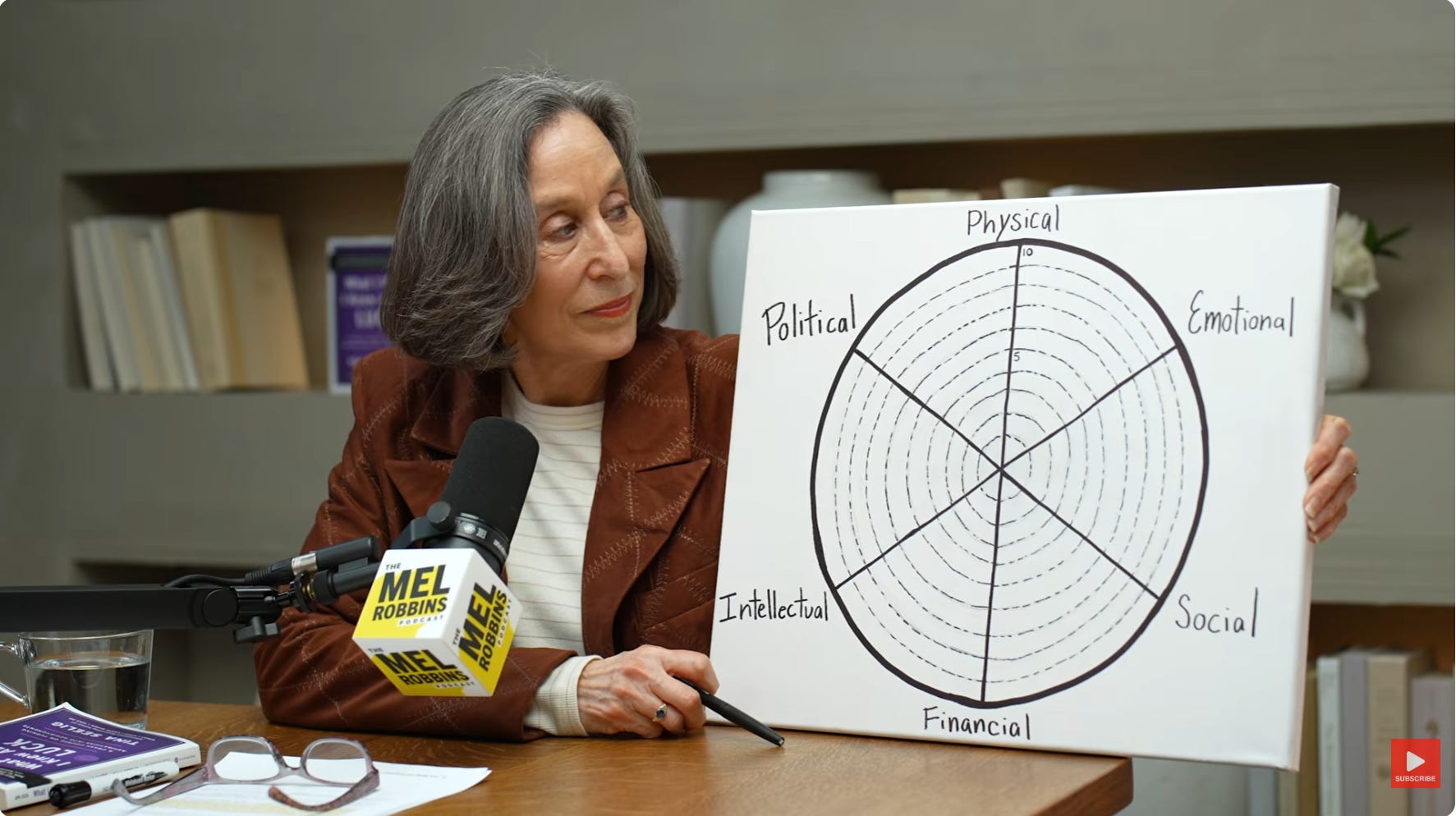
So, the very first step is to assess where you are today. Dr. Seelig proposes looking at these six areas while assessing your risk profile:
Physical Risk: Pushing your body past its familiar boundaries or testing your comfort level with some physical danger.
Intellectual Risk: Intentionally stretching your mind, challenging your thoughts, and tackling complex problems where you don’t automatically know the answer.
Social Risk: Your willingness to face potential embarrassment, awkwardness, or rejection by others. (This is often the hardest gate to open when we decide to drop the mask and stop performing for the comfort of others).
Financial Risk: Taking actions that jeopardize your money, wealth, or steady material security.
Emotional Risk: Opening up your inner self, showing vulnerability, and risking heartache or emotional discomfort.
Political (or Ethical) Risk: Challenging the established status quo, standing up against a system, or championing an unpopular idea within a group.
If you want to better understand how to assess each area, including some deep dive comments on the exercise, there is a quite recent episode of Mel Robbins’s podcast featuring Dr. Seelig that breaks this down beautifully. (You can listen here. The section from 29:00 to 37:00 is particularly relevant).
Once you finalize the risk level assessment, we can move on to reflecting on it and deciding what actions to take next.
Why Taking Small Risks Matters
In her TED Talk (and yes, I know TED talks are less popular than they once were), Dr. Seelig emphasizes changing the relationship you have with yourself by taking small risks to step out of your comfort zone. (You can watch it here).
Her larger point is about the idea of “luck”, or, in other words, the opportunities you might encounter in your life. But let’s focus purely on the risks for a moment.
She points out a very common trap: “The problem is, as we get older, we rarely do take a risk. We sort of lock down the sense of who we are and don’t stretch anymore.”
Since this entire journey of life realignment and coming back to yourself is about change, you are about to enter a process of small experiments: trying, testing, questioning, and shifting things around.
The way you ‘design’ these micro-steps and how far you go with them is, no surprise, driven by your current risk level setup.
If your personal reflection tells you that there is room to challenge the current risk level system, you can use these questions to explore this topic further:
What currently drives your risk tolerance?
How much is it aligned with your core values?
Is this risk profile even yours, or is it conditioned from the past?
Does your risk level help you let in what you want more of in your life?
In the above-mentioned Mel Robbins’s podcast episode with Dr. Seelig, they explain that taking a risk, whether it is aligned with your current profile or the one you want to build, can shift your entire mindset.
Instead of feeling like life is running you over, or that there are no opportunities, you realize:
There is something I can do.
I can choose to follow my current risk profile, or I can actively stretch myself a bit in one or two areas.
The entire point is to be aware of your risk levels and consciously manage them depending on your life realignment goals, the stage of life you are in, or what you currently need.
As you start taking small, intentional risks that are fully aligned with your conscious decisions, you might want to keep track of your progress. Naturally, some questions will appear:
How does this practice change my relationship with uncertainty?
How have others responded to me?
What new opportunities did I create?
How has my risk profile changed over time?
Do Not Change Your Risk Profile If You Don't Want To
I am not going to try to convince you to change your risk profile.
What I presented is simply material for your internal work, honest self-discussion, and independent decision making.
I do believe, though, that understanding your current risk profile gives you honest insights into why certain things are happening or not happening in your life.
As you continue your journey of calibrating your internal compass, you will discover that risk tolerance is naturally linked to your agency.
The more you rely on yourself and trust your own opinions, beliefs, and values, the more you feel the need to take full responsibility for every aspect of your life.
Risk tolerance is the ultimate filter here. It holds back or releases your agency and dictates its direction.
Over time, you might want to reflect on whether there is a gap between your core values (and what you want more of in your life), and your actual risk levels, which act as gatekeepers.
If you truly want to build a life entirely on your own terms, those gates eventually have to be aligned with your true life appetite. No more, no less, but aligned with what is yours.
If you enjoyed this, check out some of my other Life Realignment for Introverts articles:
Introverted Women:


Introvert Life Realignment:


It's so interesting to think of risk-tolerance in these various areas. On first glance, I think I have a higher risk tolerance intellectually and even a bit physically given the solo travel I've done. I'm also surprised by how much financial risk I've become comfortable with in my career transition. But I see so clearly that my emotional risk tolerance is low, which is an interesting area to dive into further. Thank you for this next step!